
How Can We Help?
-
cPanel
-
- Mailing Lists
- Default Address
- Autoresponders
- Forwarders
- Email Accounts
- Spam Filters
- Track Delivery
- Global Email Filters
- Email Filters
- Address Importer
- Encryption
- Email Disk Usage
- Calendar Delegation
- BoxTrapper
- Configure Greylisting
- Email Routing
- Filter Incoming Emails by Domain
- Email Deliverability
- Authentication (SPF and DKIM)
- Show Remaining Articles (4) Collapse Articles
-
-
WHM
-
- SSH Password Authorization Tweak
- Apache mod_userdir Tweak
- SMTP Restrictions
- Compiler Access
- Configure Security Policies
- Password Strength Configuration
- cPHulk Brute Force Protection
- Security Questions
- Manage External Authentications
- Two-Factor Authentication
- ModSecurity™ Vendors
- ModSecurity Configuration
- Manage root’s SSH Keys
- Manage Wheel Group Users
- Host Access Control
-
- Terminate Accounts
- Quota Modification
- Modify an Account
- Change Site’s IP Address
- Create a New Account
- Manage Account Suspension
- Upgrade/Downgrade an Account
- Limit Bandwidth Usage
- Force Password Change
- Email All Users
- Reset Account Bandwidth Limit
- Password Modification
- Skeleton Directory
- Rearrange an Account
- Raw Apache Log Download
- Modify/Upgrade Multiple Accounts
- Web Template Editor
- Unsuspend Bandwidth Exceeders
- Show Remaining Articles (3) Collapse Articles
-
- Articles coming soon
-
- Articles coming soon
< All Topics
Print
File Manager
Posted
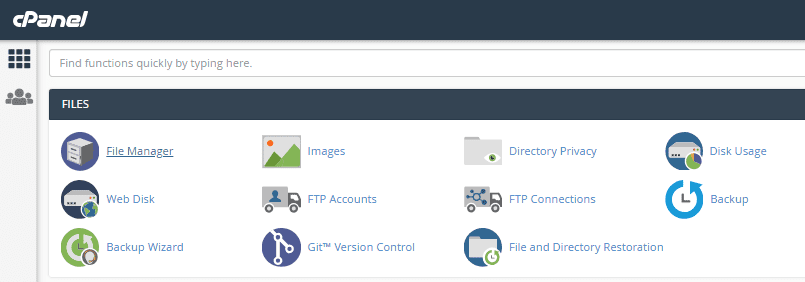
Log in to your cPanel>> FILE section >> File manager
- Scroll to the Files section and click on File Manager.

- This will open the File Manager where you will be shown a hierarchical list of your main folders. It is very similar to the file manager used in Windows

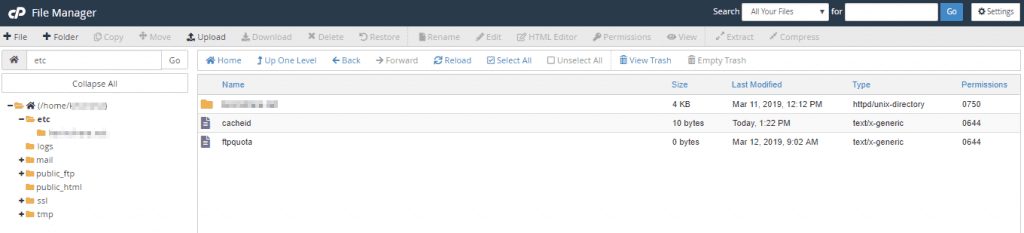
When you first use File Manager, you should click on the Settings icon (top right corner) to specify its default settings.
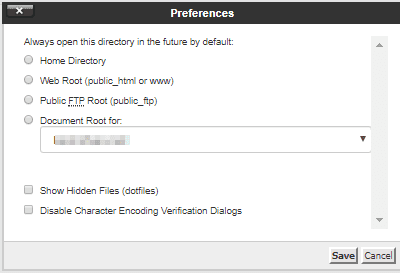
- This allows you to select the directory which you want File Manager to open by default. It also lets you enable the Show Hidden Files (dotfiles) option which will display the files whose names start with a dot (.), such as .htaccess.
- Click the Save button when you have made any changes.
- The tools you need to manage your files are displayed in the ribbon at the top of the File Manager pageThese enable you to undertake the following actions:> Add a new file
> Add a new folder
> Copy a file or folder
> Move a file or folder
> Upload a file or folder
> Delete a file or folder
> Restore a file or folder
> Rename a file or folder
> Edit a file
> Edit HTML
> Change permissions for a file or folder
> Extract compressed files or folders
> Compress files or folder - If you wish to make any changes to an existing file or folder, you will need to locate it in File Manager and select it, so it is highlighted, like the ‘mail’ option below.
Once this is done, you can use the relevant tool to carry out your desired actions.
 These enable you to undertake the following actions:> Add a new file