
-
cPanel
-
- Mailing Lists
- Default Address
- Autoresponders
- Forwarders
- Email Accounts
- Spam Filters
- Track Delivery
- Global Email Filters
- Email Filters
- Address Importer
- Encryption
- Email Disk Usage
- Calendar Delegation
- BoxTrapper
- Configure Greylisting
- Email Routing
- Filter Incoming Emails by Domain
- Email Deliverability
- Authentication (SPF and DKIM)
- Show Remaining Articles (4) Collapse Articles
-
-
WHM
-
- SSH Password Authorization Tweak
- Apache mod_userdir Tweak
- SMTP Restrictions
- Compiler Access
- Configure Security Policies
- Password Strength Configuration
- cPHulk Brute Force Protection
- Security Questions
- Manage External Authentications
- Two-Factor Authentication
- ModSecurity™ Vendors
- ModSecurity Configuration
- Manage root’s SSH Keys
- Manage Wheel Group Users
- Host Access Control
-
- Terminate Accounts
- Quota Modification
- Modify an Account
- Change Site’s IP Address
- Create a New Account
- Manage Account Suspension
- Upgrade/Downgrade an Account
- Limit Bandwidth Usage
- Force Password Change
- Email All Users
- Reset Account Bandwidth Limit
- Password Modification
- Skeleton Directory
- Rearrange an Account
- Raw Apache Log Download
- Modify/Upgrade Multiple Accounts
- Web Template Editor
- Unsuspend Bandwidth Exceeders
- Show Remaining Articles (3) Collapse Articles
-
- Articles coming soon
-
- Articles coming soon
Edit System Mail Preferences
- login to >>whm >>Server Contacts >> Edit System Mail Preferences
- Navigate yourself to Server Contacts >> Edit System Mail Preferences
 You can also type “System Mail” in the search bar and click over the Edit System Mail Preferences link.
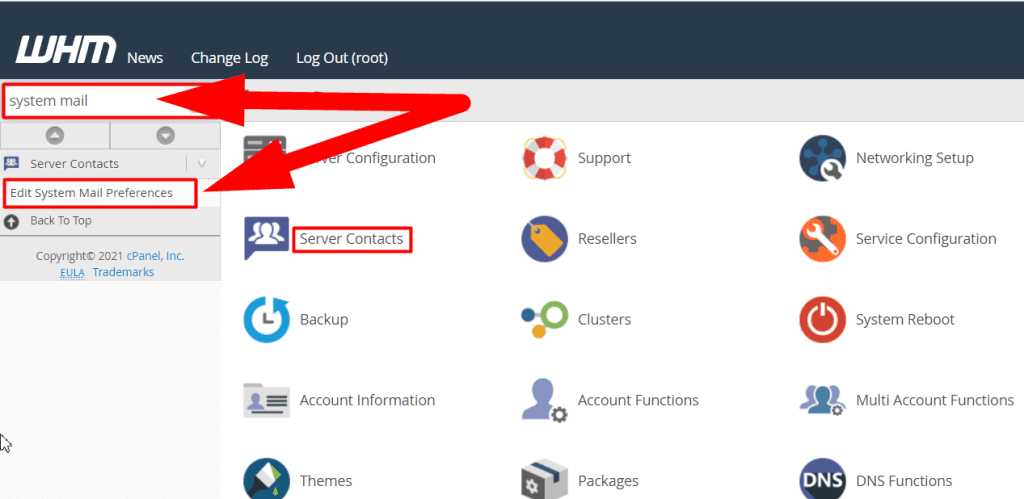 You can also type “System Mail” in the search bar and click over the Edit System Mail Preferences link.
Accessing System Mail Preferences WHM
- That’s it, you’ll be redirected to the Edit System Mail Preferences page where you can perform all the mail preferences settings.
Edit System Mail Preferences in WHM
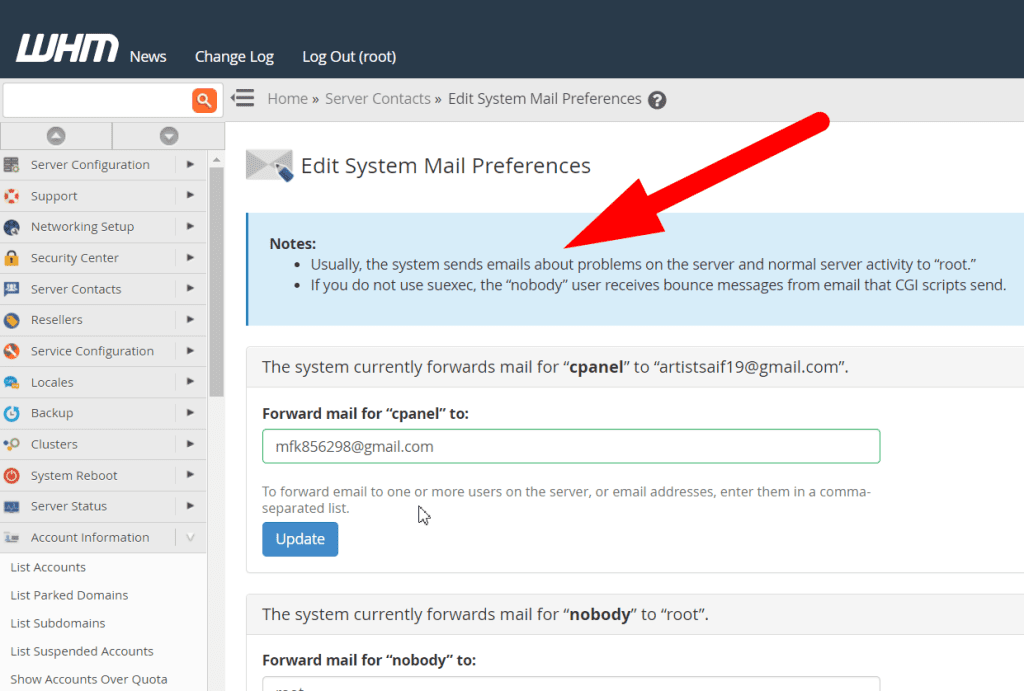
Once you land there, you’ll see the below notes on the top of your the page.
Notes:
§ Usually, the system sends emails about problems on the server and normal server activity to “root.”
§ If you do not use suexec, the “nobody” user receives bounce messages from email that CGI scripts send.
It defines how the system sends emails to the server to root, and an alert in the second point.
Mail Preferences Notes
Scroll down to the Forward mail for “cpanel” to box. Type the email address you want to send notifications of all the email alerts hosted in your server. Other than this, you can also select any existing user to send cpanel email notifications.
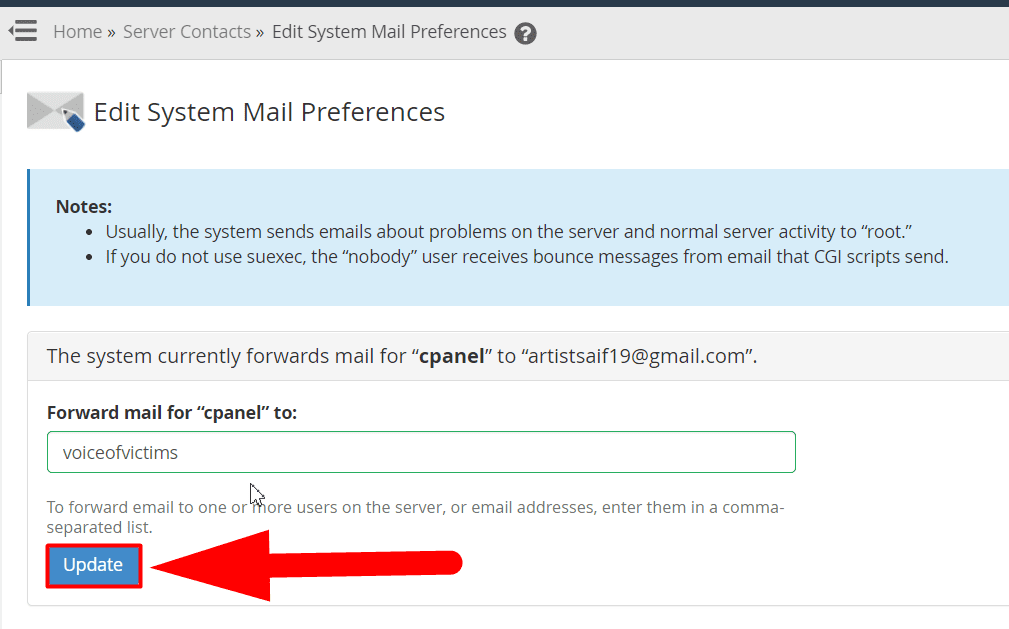
Edit System Mail Preferences Section
Hit the Update button to apply the changes immediately. Once updated, ‘The system currently forwards mail for “cpanel” to mail@domain.com’ will be changed without even re-loading the entire page.
Current Forwarding Email
Likewise, you can use the above steps for the “root” and “nobody“.
Moreover, below are the brief explanation about the type of emails you can receive from each of the system users.
- root– Email associated with the “root” system will receive notifications about the problems and activity on the server.
- cpanel– Email associated with the “cpanel” system will receive cPanel accounts (disk quota, bandwidth usage, emails per hour limit exceed, etc.) notifications.
- nobody– This system email account receives alerts about problems that are related to the Apache Webserver. As mentioned in this feature’s notice – if the user is not using suexec, all notifications sent to “nobody” from CGI scripts will bounce.